
How to clean, sharpen, disinfect and lubricate garden pruners and tools
To prevent the spread of disease from an infected plant to another, it is important to clean and disinfect tools coming in contact with plants.1,2 Tools, such as pruners, should be disinfected after working with on an infected plant and when moving to a different garden site. Since one does not always know that a plant is infected, it is best to disinfect tools as you move from plant to plant. Additionally, disinfection of tools should be done at the end of the growing season or in the spring if you failed to do it in the fall.
Well maintained garden tools, such as pruners, with a sharp blade are more effective than one with a dull blade. A sharper blade typically delivers a sharper cut with less tearing and crushing of the plant tissue, decreasing the likelihood of infection from pathogens.
This article will provide a description of how to maintain garden tools, such as pruners. Below are descriptions of procedures including: cleaning, sharpening, disinfecting, and lubrication (that generally should be done in the order listed.)
Procedures to clean, sharpen, disinfect and lubricate garden tools
If your pruners or tools are easy to disassemble, consider taking them apart because it is easier to clean and sharpen the blades when they are disassembled. If you disassemble them, take pictures, which can be used as a guide when reassembling the pruner. If disassembly is difficult skip this step.
CLEAN: To clean pruners or tools3,4:
- Assemble the appropriate safety equipment, which typically includes safety googles, rubber or latex gloves, a long sleeve shirt, long pants, & closed-toe shoes.
- Clean a tool before sharpening it. A stiff brush may be needed to remove debris. Always wash the tool with soap and water or detergent to remove dirt, grime, and sap. If needed, a hard spray of water or a pressurized sprayer can be used. Wipe pruners dry.
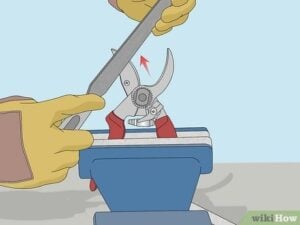
SHARPEN: To sharpen pruners:
- Assemble the appropriate safety equipment- Similar to Clean #1 above. In addition, use leather or Kevlar gloves. Protect your eyes.
- Assemble supplies: Supplies to clean a for a small blade (e.g. hand pruners) are listed in the Table 1.
| Table 1: Supplies to Clean a Small Blade 5,6 |
|---|
| Steel wool and WD-40 for rust removal -if the rust is bad you may need wire brush and 400-600 grit sand paper |
| General purpose oil (3-in-1 or mineral oil) to lubricate joints & rust protection |
| Clean rags (2 or more dry,1 oily) |
| 6” smooth file: 1 side flat & the other curved for small blades |
| File card for cleaning files |
| A vise, wrench or multi-purpose tool to secure the item |
| *For harder steels and larger blades and a video consult the references 5 and 6. |
- Use steel wool to remove rust. For difficult to remove rust, apply WD-40 and let rust soak in it for 10 minutes. Then remove rust with a clean cloth and remove the remaining rust with steel wool.
- Determine which file surface needs sharpening. Secure your tool. Use file on beveled edge only and with long swiping strokes that are parallel to the blade’s existing factory angle (typically 23 to 25 degrees). File the bevel the full length of the blade. As you file the blade, it will become shiny.
- As the file sharpens, burrs will develop on the back of the blade. Remove “burrs” by running the flat side of the file over the back of the blade.
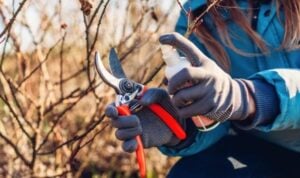
Disinfect: Use one of the following disinfectants to sanitize surfaces to remove pathogens including bacteria, fungi and viruses:
- Rubbing alcohol (70% or greater isopropyl alcohol) is best for small hand tools and hand pruners. Use safety equipment described in Clean Step #1. Also, when using a disinfectant, check the label, and use the appropriate safety precautions. Dip, wipe or spray items to be disinfected with rubbing alcohol, and allow to air dry.
- Note: Do not mix disinfectants with other chemicals.
Limitations: It does not effectively disinfect tools used with apple trees containing fire blight.
- Disinfectant products containing 1% alkyl dimethyl benzyl ammonium saccharinate. A common household disinfectant (Lysol®) contains this ingredient. This disinfectant does not corrode metal and will not damage fabric. However, do not use it on polished wood, painted surfaces or acrylic plastics. This product is typically used to disinfect small hand tools such as pruners or blades, hard to reach areas, or ornate areas (i.e. trellises, hanging baskets).
How to Use:
Check the label to determine if the product comes ready to use and follow instructions if preparation is required.
Dip or spray the item with this disinfectant. Let your item air dry.
(The product described is Lysol® which is a registered trademark of Reckitt Benckiser Group.)
- A 10% Bleach solution made by combining one part bleach with nine parts water in a container that is large enough to immerse the tool to be sterilized.3,4
Beware: This product damages fabric and corrodes metal. It is not recommended for repeated use with pruning and cutting tools that require a sharp edge, because it can create pits and nicks in the metal4. Municipalities often have specific rules regarding whether small amounts of diluted bleach are permitted in the sewer system. Never pour bleach into a septic system. Do NOT pour it in your garden as it can harm plants and beneficial soil organisms.
Uses: Disinfecting spades, stakes, poles, simple trellises, tomato cages, large containers.
How to use: After cleaning the item, dip or spray tools with the 10% bleach solution making sure all parts are treated. Allow to air dry.
Lubricate: After the tools air dry completely, apply a general-purpose oil to the blades and the hinge mechanism to prevent rust and ensure smooth operation.
Maintain your tools and they should last for years and support healthy plants in your garden!
References
- Pruning Trees and Shrubs Factsheet University of New Hampshire -Extension
- Ohio State University Factsheet Ohio State University
- Clean & Disinfect Garden Tools
University of Minnesota: Julie Weisenhorn and Extension educators Natalie Hoidal and Annalisa Hultberg