
Chinese Privet (Ligustrum sinense)
Description
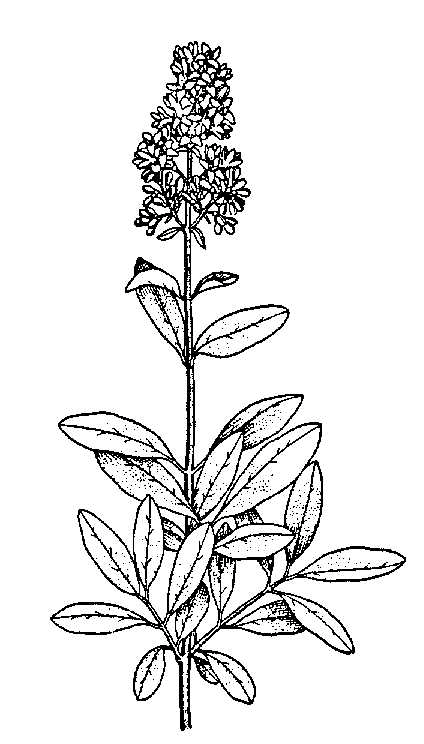
A member of the olive family, Chinese privet is a shrub that can grow to 12 feet in height. Leaves are oval or elliptical, 2 inches long, and opposite. Chinese privet is distinguished from other privets by the presence of fine hairs on the twigs and underside of leaves.
Small, white, four-petaled flowers grow in clusters at the ends of branches. The fleshy blue fruits, less than a quarter-inch in diameter, contain a hard seed. Several other privet species have been introduced into Virginia, but none have proven as invasive as Chinese privet.
Habitat
Chinese privet prefers wet, damp habitat. It is usually found in low woods, bottomlands, streamsides, and disturbed areas.
Distribution
Native to China, Chinese privet is found in Virginia, North Carolina, Georgia, Tennessee, and Kentucky. This plant is found throughout most of Virginia.
Threats
Chinese privet can dominate the shrub layer of an invaded habitat, altering species composition and natural community structure by choking out native plant species. It shades out all herbaceous plants. Thousands of acres have been invaded by Chinese privet in North Carolina.
Control
Controlling plants by hand is effective for plants with stems 1 inch or less in diameter. The entire root must be removed. Mechanical methods such as cutting or plowing will result in an increase of growth.
Chinese privet can be controlled with use of a glyphosate herbicide. Glyphosate herbicides are recommended because they are biodegradable. However, glyphosate is a nonselective systemic herbicide that affects all green vegetation. Safe and effective herbicide use requires careful knowledge of the chemicals, appropriate concentrations, and the effective method and timing of their application.
For Chinese privet, a foliar application in late summer is recommended. To avoid killing desirable plant species, spray in late fall after most natives have dropped their leaves. A combination of cutting followed immediately by application of glyphosate to the stump is reported to be the most effective in ensuring control.
More Information
For more information on native plant conservation, contact the Virginia Native Plant Society. For information on Virginia’s natural areas and natural heritage resources, contact the Virginia Department of Conservation and Recreation’s Division of Natural Heritage.
Virginia Native Plant SocietyBlandy Experimental Farm
400 Blandy Lane, Unit 2
Boyce, VA 22620
540-837-1600
Virginia Native Plant Society website
Virginia Department of Conservation and Recreation Division of Natural Heritage
Source and Illustration Credit
Adapted from the Virginia Department of Conservation and Recreation and Virginia Native Plant Society fact sheet dated December 1997.
The botanical illustration is from New Britton and Brown Illustrated Flora of the Northeast U.S. and Adjacent Canada, by H. H. Gleason, New York Botanical Garden Scientific Publications. Used with permission in the original fact sheet.