
24 species of St. John’s Wort are native to Virginia
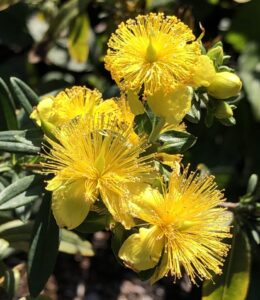
Identifying St. John’s Wort
St. John’s Wort is the common name for plants of the genus Hypericum, in the family Hypericaceae. They are found world-wide, and include 490 different species. The USDA lists 24 species as native in Virginia (St John’s Wort 24 Species List). The common name is thought to be derived from the Christian feast day of St. John the Baptist, which occurs in June, when the plants first begin to flower.
St. John’s Wort includes herbaceous perennials and shrubs with multiple stems, having a compact, mounded habit. They may be deciduous or evergreen, with opposite or whorled green leaves of various shapes, and bright yellow flowers that appear from June through August. The flowers provide nectar for bees, butterflies and other pollinators. In the fall, some species produce colorful berries for birds.
Benefits and Landscape Uses
For centuries St. John’s Wort was used as an herbal treatment for various human ailments. (The controversial agent Hypericin is derived from the leaves and flowers.) Today it is grown in pollinator gardens, on banks and slopes, as a mass planting or hedge.
Selecting Species and Cultivars
St. John’s Wort spreads by rhizomes (“runners”) and self-seeds. Many species are aggressive spreaders, particularly in disturbed areas. While no species have yet been designated as invasive in Virginia, they are in other states, so caution is advised in selecting the species/cultivar for your situation. A very good article on this topic, entitled “St. John’s Wort – Learn How to Choose” written by Susan Martin, is available on What Species to Choose.
Many other cultivated varieties of St. John’s Wort have been, or are being developed. Sometimes referred to as “Nativars,” they are bred for particular traits. (Further information on this topic is “Native, or Not So Much?” written by Janet Marinelli, available on Native or Not So Much Article.) One that is available locally in Henrico County is Sunny Boulevard ‘Deppe’® (the parent plant is H. kalmianum or Kalm St. John’s Wort) that has a compact habit and is marketed as “non-invasive.”
Growing Conditions and Care
All St. John’s Wort varieties do best in full sun, and well-drained soils. St. John’s Wort is low maintenance and will tolerate some drought once established.